Showing posts with label gear. Show all posts

Saturday, October 18, 2014

Bagging the Bay Area

California Bag

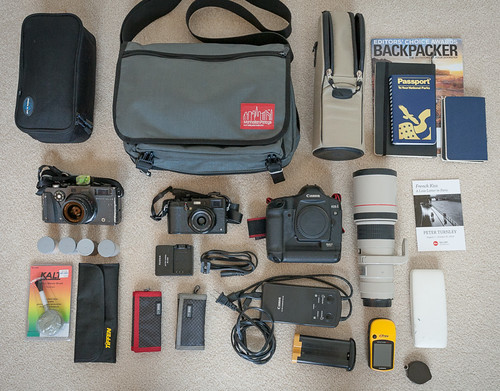
Another year, another trip, another bag shot (last year, +JCH). This time, the destination was the Bay Area of northern California. The bag is the same, but the contents are almost completely different.

Fujifilm X100S, from LensRentals and the main camera of the trip. I'd been drooling over the Fuji cameras for a while, but I'd never actually used one. This trip seemed like the perfect opportunity. I plan to put my impressions of the X100S in another post.

Hasselblad Xpan, because I can't seem to leave it behind on big trips, and I had an unfinished roll of Velvia inside.

Canon 1D Mark II, the old sports workhorse. Surfing is one of my favorite sports to shoot, and northern California is a bit of a mecca for surfers, so this was a no-brainer in spite of the size of the kit. I'm pretty sure the 1D charger alone is larger than the whole Fuji kit.

Canon 400/5.6 L USM, my current go-to, long-reach sports lens. It's about as good as a lightweight 400mm lens can be. I used to have the Canon 400/2.8 L USM, which was a stunning lens, but it was a beast to travel with, and was hard to justify owning once I stopped shooting sports regularly.

Manhattan Portage Europa Medium Messenger Bag, because it's light weight, well made, looks sharp, and can swallow a ton of stuff when expanded. Even I was amazed when I got the 400 in there with the 1D, 1D charger, and Xpan.

Sea to Summit Soft Cell, otherwise known as the Xpan Go Bag. These days it's more organized thanks to the Tiffen filter case to the bottom.

Canon 400/5.6 lens case, because the Manhattan Portage bag doesn't have any padding. I hate overly-padded bags that add bulk and weight.

Two rolls of Kodak Portra 400, a nice, general purpose film for traveling, with good color rendition.

One roll of Kodak Tri-X 400, which needs no explanation.

One roll of Ilford FP4 Plus 125, which I've been meaning to try for a while now.

Think Tank Pee Wee Pixel Pocket Rocket (red), for the the X100S SD cards. I had to scrounge for enough SD cards for the trip since most of my storage is compact flash for the ol' 5D and 1D.

Think Tank Pixel Pocket Rocket (gray), for the 1D CF cards. I brought way more than I needed, but this was one of the few opportunities I would get to shoot surfing (we don't get much surfing here in Denver), so I certainly didn't want to run out. I also brought some smaller, obsolete CF cards that I could just give to people if they needed a photographer in a pinch.

Kalt Blower Brush, for the battle against dust.

Garmin eTrex Venture HC, so I'd know where I'd been. It's also fun to add new trails and locations to OpenStreetMap whenever possible.

Extra pair of glasses (in the white case), so I'm not completely helpless if something happens to my main glasses. Really they're just the glasses from my previous prescription; better than nothing.

National Park Passport, because it's fun to get stamps for the parks my wife and I have visited.

Moleskine notepads, for writing stuff down, though I find myself using my iPhone for notes more and more.

Peter Turnley card, from the San Francisco Leica Store, which had his French Kiss series on display. If you ever get a chance to see his work in person, I highly recommend it. The SF Leica Store itself is a very nice space with plenty of new and old gear to drool over. The staff were very friendly and didn't bat an eye when I took out the Fuji for a couple shots. It definitely made me wish I had my M6 or CL with me though.

I didn't carry all this gear around all the time. The San Francisco Bay Area is hilly (understatement) and I certainly didn't want to bring the 1D and 400. There were times when I wanted the Xpan, but even that was too heavy for a full day on foot. Most of the time I just had the X100S, a bottle of water, and a pull-over fleece in the bag. In the end, one decent camera is all you really need.

Sunday, October 27, 2013

Bagging Europe

Just got back from Europe last week. My wife and I flew into Paris, took trains to Heidelberg, Wurzburg, Rothenburg, Fussen, then flew out of Venice. Needless to say, it was quite a trip.

Paris, Bavaria, Venice

The photo above is the gear I took with me, which I took just before we left. I wish I had a before-and-after shot, but when you get back from three weeks on the go, you just kind of crash. I only got all my film mailed off to NCPS a couple days ago. That's for another blog post though. As I was putting the bag together, I kept my Notes from Rome post in mind. Here's the breakdown:

Hasselblad Xpan, because I just couldn't resist the urge to take it, even though it's really heavy.

Leica CL, because I wanted to take a Leica, and it's lighter than the M6.

Leica 90 f/2.8 Tele-Elmarit, for a little more reach, or in case someone needed a portrait taken (no one did).

Canon S95, for all the stoopid pictures in bad light, plus it can shoot video.

Polaris light meter, because camera light meters can't always be trusted.

Sea to Summit Soft Cell, otherwise known as the Xpan Go Bag. These days it's more organized thanks to the Tiffen filter case to the right.

Manhattan Portage Europa Medium Messenger Bag, because it's light weight, well made, looks sharp, and can swallow a ton of stuff when expanded. It even had room for a music box on the return trip.

Nine rolls of Kodak 400TX (Tri-X), which is my go to black and white film with lots of latitude.

Seven rolls of Kodak Portra 400, which I mainly planned to use in the Xpan. It turned out that Venice was very colorful though, so I did the unthinkable and put color film in the CL as well.

One roll of Fuji Pro 400H, which has been sitting around since before I switched to Portra.

One roll of Ilford FP4 125, in case I wanted to shoot some higher quality black and white.

Kalt Blower Brush, for the battle against dust. Thankfully there are no worries about dust on the sensor when you use film.

Garmin eTrex Venture HC, so I'd know where I'd been. It's also fun to post far-away places on Strava.

Extra pair of glasses (in the white case), so I'm not completely helpless if something happens to my main glasses. Really they're just the glasses from my previous prescription; better than nothing.

Toothbrush, because I'm paranoid like that.

Day to day on the trip I didn't lug all this gear around. Usually I'd carry either the CL or the Xpan, depending on what I was expecting to shoot. If I took both, then I just needed to remember to give my shoulder a rest now and then. The coffee shops of Europe make it very easy to take breaks.

I like the way the film and small-digital complimented each other on this trip. I could take all the touristy, I've-been-here shots with the S95, which let me conserve my film resources and be more considerate when I was in "real" photography mode. Having both also provided some insurance that all the shots from the trip would not be lost. In the end, I came back with about 10 rolls exposed, plus about 500 digital pictures from the point-and-shoot.

More to come when I get the film back...

Monday, January 16, 2012

Camera Porn How To

Product photography is a curious thing. For instance, here's a picture of a Leica M6 with a dual-range 50/2 Summicron with ugly goggles, an uglier strap, and tape all over it. Yet you still want it.

M6 Dual-Range

Sometimes it really is the object itself that you want, and it doesn't matter how good or bad the photo is. However in most cases, people have probably never actually touched the object, so all they have to go on are some pretty pictures and reputation/cache/speculation/marketing (cough X-Pro1). Curious.

Anyway, here's a little how-to for creating your own camera porn for the masses. It's pretty straight forward. All you need is:
  • A semi-long lens (100mm+)
  • A soft light source (indirect light from a large window, or a softened off-camera flash)
  • A clutter-free background (any plain wall will do)
  • Oh yeah, and a camera


Camera Porn Studio

For these shots, I used an old Nikon SB-28DX flash triggered from my 5D with a low-end Pocket Wizard. The flash fired at 1/4 power through a Westcott umbrella, which softened the light.

Initially I tried using my trusty 50/1.8 lens, but quickly discovered that this was not long enough to keep the background clutter out of the lens's perspective. I switched over to the 24-105/4 (at 105mm), which did the trick of narrowing the perspective of the background, removing unwanted junk from the scene.

I also wanted to make the object stand out, so I had to make sure that there was enough light fall-off between the object and the background, so the object would be much lighter. To do this, I had to keep the light source close to the object (about 2 feet), but far from the background (about 12 feet).

In order to kill any ambient light in the shot, I used the fastest shutter speed I could. The 5D syncs at 1/200, so all the pictures were taken at 1/200 at f/11.

For more information on general product photography, I highly recommend you go check out Strobist. And now back to our regularly scheduled camera porn...

Leica M6

Visoflex 400

Visoflex 400

Leica CL

Saturday, December 17, 2011

Gearing up for Southern Africa

The following is a guest post from my good friend, Tom Hennen. He and his wife recently returned from a three week trip to southern Africa. I've asked them both to share some of their experiences in a series of blog posts.

Integration

One of the first things I learned about Amy, my wife, was that she wanted to go to Africa. So it was no surprise that six years after we’d met we were finally on our way. What was a surprise was how long we’d be gone, three weeks. Three weeks of scrambling over the tops of waterfalls, game drives and walks, death marches to the bottom of large ravines, ostrich riding, exploring caves, harassing penguins, and petting lions.

Knowing that Africa might be a once in a lifetime trip I wanted to document the trip and take some excellent photographs. When we planned the trip, the little photography experience I had was limited to framing photos with our point and shoot. I didn’t know anything about f-stops, ISO or crop factors. Luckily I had about a year to prepare so we purchased a Sony A580. In order to get comfortable with it I started work on a Photo-a-Week project. Each week I’d post a photograph with a different theme. Many of the early weeks were rough, but I eventually got the hang of it and really learned how to use the camera.

When I started the project I was using the kit lens (Sony 18-55 3.5-5.6) and a telephoto zoom (Sigma 70-300 APO 4-5.6). Between the two of these I was definitely getting the range that I wanted, but I didn’t find it very flexible when walking around. I’d often find myself seeing a great shot but having the wrong lens on. To top it off, walking around with both lenses made for a heavy bag. I knew changing lenses on the trip wouldn’t work since there are so many fleeting moments on game drives. I also knew weight would be a problem since I’d be carrying the camera and equipment around all day. With that in mind I wound up buying a super-zoom, the Sony SAL18-250 3.5-6.3. It’s not quite as long as the 70-300, but the flexibility it afforded was well worth it.

DSC07445

Another concern was how I was going to carry the equipment. Theft is always an issue, no less so in southern Africa. Many camera bags scream “steal me” and since we were going through so many border crossings I thought it was important to have something inconspicuous. After searching for a while I chose the ONA Union Street bag. It had plenty of room for my equipment and other essentials like bug spray and sun screen. Most importantly, it doesn’t look like a camera bag.

With the lens and bag issue settled I had my packing list: camera body, 18-250 lens, charger, spare battery, lens cloth, lens pen, dust bulb, and bag. The only remaining question was if I wanted to bring a tripod...

Sunset on the Zambezi

Sunday, June 5, 2011

Notes from Rome

Spanish Steps

Itinerary


Day 1 (May 19, 2011): Check into our apartment near Piazza del Popolo, get groceries, eat pizza at 06 Cafe, visit Spanish Steps.
Day 2: Castel Sant'Angelo, Vatican Museum
Day 3: Colosseum, Palatine Hill, Roman Forum, night pictures along Tiber
Day 4: Bike ride along the Appia Antia
Day 5: Basilica San Giacomo, Pantheon, Piazza Nuova, Villa Borghese
Day 6: Ostia Antica

Gear


Canon 5D
Canon 24-105/4 L IS USM
Canon 50/1.8
Canon S95 (amazing P&S, BTW)
Canon SD800 (knock-around/backup)
Slik Mini-Pro V tripod
Kelty Basalt backpack
Think Tank Chimp Cage
Think Tank Pee Wee Pixel Pocket Rocket
Think Tank Pixel Pocket Rocket

Etc.


Photographic fulfillment can be an illusory beast. While Rome was very personally rewarding, the 10 pictures I took at the Suburban Airport seem more photographically rewarding than all the 450-ish pictures I took in Rome. As a photographer, it's difficult to separate personal fulfillment from photographic fulfillment. If being a visitor automatically makes you a tourist, then how does one find photographic fulfillment in a sea of tourist photography?

Some would say that it's a film vs. digital thing; that shooting film forces you to slow down and take more care on when and how to shoot. To some extent I agree, but there are other, more important factors to consider.

If you are traveling with others, you have to put the group's priorities first. If the group's priority is not photography, then you're simply going to have to make due with the time and place as is. Waiting for the Light does not apply.

Iris

So this begs the question, should one bother lugging a DSLR if there's a high probability that most of the photos are going to be of the tourist variety? I'm still not sure. While there's no question that the quality of the photos coming out of the DSLR are going to be higher, there's a lot to be said for lightening your load.

Tiber Night

It really comes back to personal priorities. If you just want to take pictures for the memories, then a point-and-shoot will certainly do the trick. If you're going for more of a photo journalistic approach, then a DSLR and a solid general zoom is probably your best bet. If you want to play Henri Cartier-Bresson, then take a rangefinder with one good prime. And if you want to get all lomographic and artsy, then take a toy camera.

I tend to lean toward the photo journalistic approach, which is why I took the 5D and 24-105/4 as my primary camera. It's a solid combination that's going to reliably come away with good pictures. In other words, it was the safe option. Can great art come from playing it safe though? Is the safe option always the boring option?

I do wish I'd taken a wider lens though. The 17-40/4 would have been great for capturing the immense art and architecture. Whether I should have taken the Xpan is still debatable. I certainly wouldn't have wanted to waste a bunch of film taking tourist photos, but it's hard to shake that romantic Xpan in Rome ideal.

In the end, it's best to be thankful to be on this Earth; even more so if you have a camera in your hand.

Welcome

Sunday, April 17, 2011

Lens Selection Anecdote

Elements

My friend Pat recently came to me for some lens selection advice, so I thought I would do the right thing and pass it along here. He'd just purchased a new Canon 60D, but he did the smart thing and bought it body-only. His brother had recently purchased a Nikon D3100, and he was disappointed with the kit lenses that came with the camera. I had also advised him against the kit lenses since there are so many great lenses out there that are better suited to particular tasks. In Pat's case, he wanted a good low-light lens, a good portrait lens, and a good travel lens, all for about $1200.

He'd already ordered the 24-105/4L IS and the 50/1.8. While I'm definitely a fan of both of these lenses, but I had to explain that the 24-105 simply wouldn't be wide enough for travel photography with the 60D's cropped sensor. Also, being an f/4, it's not the greatest portrait lens. His counter argument was that he could just get a wide prime later for travel. While this was true, it would also have all kinds of drawbacks:
  • You're traveling, so it's essential to keep things light and simple; don't take two lenses when one will do.
  • Two lenses at the wide end will usually result in many lens changes when traveling. This means you're going to hold up your tour group and/or miss the shot.
  • Every lens change when you're out and about just gets more dust on you sensor.

Luckily he'd ordered the lenses from B&H, so the return policy for the 24-105 wasn't a concern. Now we just had to figure out which lenses he did need. The new EF-S 17-55/2.8 was tempting, but it just didn't seem like it would be quite long enough, plus it would have blown his budget if he still wanted to get a portrait lens. After a bit of discussion, he ended up going with the EF-S 18-200/3.5-5.6. Even though I'm generally not a fan of lenses with variable apertures, I think this was a good choice. My Nikon friends seem to get decent shots out of their equivalent DX 18-200 lenses, so Canon should at least be able to match that (don't worry, I have a soft spot for Nikon as well).

With the travel lens decided, we now had to figure out a portrait lens. This was actually an easier choice, since Canon has always had many great USM primes to choose from. Back in college I used to drool over the 100/2 prime. This would have been a bit on the long end for his cropped sensor though, so I ended up recommending the 85/1.8. It should compliment the 50/1.8 nicely for outdoor vs. indoor portraits.

So in the end, Pat will have a great Canon travel and portrait kit started with a 60D, 18-200/3.5-5.6, 50/1.8, and 85/1.8. I'm looking forward to his pictures.

Sunday, March 27, 2011

Playing Catch-Up

Continental

Ok, so let's see if we can do a little catching up here...

We stumbled across the Continental restaurant (pictured above) while we were looking for breakfast on our trip to Philly last month. This picture only partially captures the awesomeness of the decor. The food was also great. Highly recommended.

More recently (like yesterday) we went down to the Newseum. It's been on my todo list for quite some time, so I'm glad we went. The tickets were a bit pricey, but they've got a pretty impressive collection of exhibits. They're big on timelines and multimedia, which makes sense. Their collection of old newspapers and Pulitzer prize photographs was also impressive, as was the view over Pennsylvania Avenue. I also enjoyed the Walter Iooss exhibit, which is only there until the end of March, unfortunately. The food court was clearly an afterthought. Also worth noting is that the tickets are good for two days, so if you're in DC for a weekend or something, don't feel like you need to do the whole thing at once.

Also worth checking out is Cameron Booth's redesign of the DC Metro map. If history is any indicator, he will be ignored by the powers that be, but let's hope I'm wrong. His interstate highway map is also cool.

On the camera gear side of things, I've discovered that the framelines don't change in my Xpan when I put on my new 90mm lens. Now I often find the viewfinder half-way between the 45 and 90mm frameline windows, so something is clearly loose or broken. I have to tilt the camera to the right to get the 45mm window to fall back into place. Needless to say, I was disappointed, especially since the camera was fixed and CLA'ed last June. I've contacted Hasselblad in NJ, so hopefully they'll cover it. We'll see.

Sunday, January 30, 2011

Weekend Update

Just wanted to share some more Xpan shots from the batch that came back from NCPS. I also tried out the new 90/4 down at the East Wing of the National Gallery of Art yesterday; some great I.M. Pei architecture to admire. I just hope my hand-held shots are steady enough.

Excitement

National Brewing

Purple Water

Rising Harbor

Also, the Nikon FA thing was a bust. I put the new battery in, but the shutter jams on every other frame. The only way to unjam it is to switch into M250 (mechanical 1/250 mode). Luckily I didn't put any film in before testing it out. Switching the camera back and forth out of mechanical mode may be making the problem worse for all I know. I'd consider getting it repaired, but I can get a used one in excellent condition for about $120, which is probably less than the cost of a repair. I think I'd much rather have the classic workhorse F3 anyway. Now that's a camera you can go out into the middle of nowhere with.

Friday, January 28, 2011

Trois Neopan

Neopan

Three new friends arrived in the mail today with my Xpan 90/4. I've never shot Neopan before, but I'm looking forward to it.

I also got a fresh CR-1/3N battery for my trusty Nikon FA. I don't know if it even works any more, but there's only one way to find out. The last roll of film I put through it was back in 2005. It was a great camera in Paris, but it let me down in Krakow and again in Budapest, so I just keep it for sentimental value now. I think it will be ok for non-critical, local shooting around DC or something. It will be great to shoot with a camera that has an actual film crank again.

Tuesday, January 18, 2011

This is what I'm talking about

Florida Carry On

Pictured above is my carry on from a recent trip to south Florida. For the most part, it flies in the face of what I've been trying to achieve in terms of traveling light. The laptop's there, there are two camera systems (Canon and Xpan), the binoculars are there, and I brought along the tripod. I think I'm going to create a new rule of thumb: if I bring the laptop, then I'm probably not going to serious enough to use the tripod, so why even bring it.

The binoculars also come into question. However, they are nice for enjoying the moment or passing the time while waiting for the light.

As for the two camera systems, I'm not sure what to do here yet. Part of me is tempted to just take the XPan and a nice digital point and shoot like the S95 or LX5. However, it's hard to argue with the results of the good ol' 5D. I just wish its lenses weren't so flippin heavy. Maybe I should switch back to my Australian kit: 5D, 17-40/4, 70-200/2.8, and small Slik tripod in a backpack. The 24-105/4 is great, but it can't touch the unique perspectives of 17mm and 200mm.

Regarding my last post on Xpanomics, I think Tokyo Camera Style was either reading my mind (or my blog?) because suddenly there were posts on how to roll and develop film at home and how to improve as a photographer in 2011 with the one-camera-one-lens project. Filmus Monochromus was particularly informative. Unfortunately this also reignited my desire to own a Leica.

A Leica kit would certainly weigh less than a DSLR system, which fits nicely into my goals of minimalism. Hmm. Unfortunately it would also minimize the money in my bank account. :-(

Speaking of which, you can help support this blog by using the product links to Amazon. You don't even have to buy the item I've linked to, just go to Amazon through my blog and The Photo Way gets a small percentage of your purchase at no cost to you.

In any case, I'll try to get some Florida pics up soon. Happy 2011!

Tuesday, December 14, 2010

Xpanomics

So I just wanted to make a short post about the economics of shooting various types of film with the Xpan. The film prices here were pulled from B&H on 12/14/2010, and the processing and scanning prices were pulled from North Coast Photographic Services (NCPS). It assumes about $0.50 of shipping for getting the film from B&H and then shipping it to NCPS, then shipping the processed film back. It also assumes you get 21 panoramic shots out of a roll of 36.

FilmRollShipProcScanTotalPer Pano (21)Per Std (36)
Fuji Provia 400X$9.89$0.50$8.25$5.49$24.13$1.15$0.67
Fuji Astia 100F$7.55$0.50$8.25$5.49$21.79$1.04$0.61
Fuji Velvia 50$6.95$0.50$8.25$5.49$21.19$1.01$0.59
Kodak E100VS$6.99$0.50$8.25$5.49$21.23$1.01$0.59
Fuji Pro 400H$6.89$0.50$5.50$5.49$18.38$0.88$0.51
Ilford XP2 Super 400$5.64$0.50$5.50$5.49$17.13$0.82$0.48
Kodak BW400CN$5.25$0.50$5.50$5.49$16.74$0.80$0.47
Ilford FP4 Plus 125$5.09$0.50$5.50$5.49$16.58$0.79$0.46
Kodak 400TX (Tri-X)$3.45$0.50$5.50$5.49$14.94$0.71$0.42


So we can clearly see that the venerable Tri-X is the most economical to shoot, but obviously it may not give the desired results or grain. I was a bit surprised to see that Provia came out to be most expensive. $10 per roll is way too much; not sure why it's that high.

Now the real trick is to not think about how much each shot is costing you, causing you to hesitate as The Moment passes. This is especially true of street shooting. I'm curious to hear what others do to mitigate the recurring costs of shooting film. Developing and scanning yourself seem like the obvious choices, but the time and tedium (not to mention chemicals) have their own costs associated with them.

I prefer to think of the cost in terms of something to pass the time. I could pay $20 and go to an amusement park, or eat at a semi-nice restaurant... or I could shoot a roll of Pro 400H for less. For me the reward is often being there, and the pictures come afterward.

If this post bored your completely, then check out how Steve Kamb is going to travel the world for $418.

Thursday, July 1, 2010

Xpan repair story

Ok, so this travel blog is turning into more and more of an Xpan blog. But hey, why not run with it for now...

After my Shendandoah trip, I started to notice that the parallax focusing prism was just not right. I would focus on the same object from the same location with the camera in different orientations (i.e. horizontal vs. vertical) and get different distance readings on the top of the lens. Not really a problem when shooting landscapes at f/16, but nonetheless, just not right.

I briefly entertained the idea of trying to fix it myself, but after loosening a few screws to remove the top, I concluded that I was only going to do more harm than good. It was time to bite the bullet and ship it in to someone who knew what they were doing. But where to begin?

Hasselblad.com listed Greg Hollmann as the regional partner for Maryland, so I dropped him an e-mail at ghollmann@hasselbladusa.com:
The rangefinder focus on my Xpan does not seem to be completely accurate sometimes. I'd like to have it looked at, but I don't know where to take it or ship it. I'm currently residing in Baltimore.

He promptly replied:
Hi Bill,
We have a service center in NJ, they will be able to take care of you. Here is the contact info:

Hasselblad USA - Camera service center
333 New Road, Suite no. 5
Parsippany, NJ 07054
USA
Phone number +1-973-227-7320
Fax +1-973-227-1063

Great! I carefully wrapped and boxed up the Xpan with a formal letter enclosed (headers omitted here):
To whom it may concern,
The parallax focusing mechanism on the enclosed Xpan (serial no. xxSSyyyyy) appears to be loose. It seems to go completely out of alignment after I have the camera tilted to the right (i.e. right end of the camera pointed downward). By tilting the camera to the left, then shaking lightly, the focus mechanism seems to fall back into place. It's difficult to be certain that I'm getting proper focus again though. Please examine and repair if possible.

I shipped it off via USPS with delivery confirmation and $800 of insurance for $17.95. Not bad at all. Three days later I received an e-mail from Maryann Murphy at Hasselblad:
Mr. Allen
We have evaluated your camera and determined it needs to be cleaned and calibrated. It also needs the Prism to be tightened. The cost of the repair is $193.00 including shipping.

Please advise if you want to proceed. Your repair # is xxxxxx.

Generally when I think Hasselblad, I think big $$$, so it was a pleasant surprise to get a quote of $193. Of course I gave the go-ahead. The following Monday I received another e-mail from Maryann:
Hi Bill,
The repair has been completed to your xpan. It has been calibrated, cleaned and the prism tightened. I just need a credit card and it will be shipped.

Now I can be slightly paranoid when it comes to credit card numbers, so I decided to give her a call the next day instead of simply e-mailing her my credit card number. She was ready with my order when I called though, so the call was about as painless as possible.

The camera arrived a few days later via UPS (after a three rounds of delivery tag). I took it out of the box and was very pleased with what I saw. The viewfinder was pristine and the focusing mechanism was smooth, tight, and accurate. If it weren't for the wear on the finish, I'd have thought I was holding a new camera. The only down side of the whole thing was that the battery had run down during the journey, but that's no big deal. I keep spares in my Xpan Go Bag.

So if your Xpan (or any Hasselblad) is starting to show its age, I hope this article helps quell your fears a bit. Of course, this is the USA, so I have to list the following disclaimers:
  • Your mileage may vary greatly in terms of pricing and timing depending on what's wrong with your camera.
  • I have absolutely no relationship with Hasselblad; I did not get any freebies, discounts, or other compensation for writing this article.
  • Please confirm any contact info I have listed here, as it may have changed. Do not blindly ship your beloved camera to Parsippany, NJ.

And don't worry, I'll get back to posting pictures soon.

Tuesday, March 30, 2010

Another wave of photos

I've been pretty bad about posting lately, so here comes another wave of photos, this time from the Aquarium of the Pacific in Long Beach, California. I walked in with nothing but the 5D and, more importantly, the 50/1.8. The thrifty fifty saved the day in those dark aquariums. The only problem is that it makes me want the 50/1.4 even more. Hmm. Anyway, enjoy!

Jelly

Fish

Lobster

Starfish on Glass

Yawn or Rawr

You are what you schlep

I've recently been inspired by Jason Travis's Persona series that was commissioned by The Atlantan. The basic concept is that "you are what you schlep." Pretty simple, but amazingly insightful. On top of that, Jason takes some pretty cool portraits. As I currently only have myself to profile (and I don't feel like taking a self-portrait tonight), I decided to go more in the direction of The Items We Carry flickr group. What I find particularly interesting about these photos is that, while they answer many questions about a person, they seem to inspire even more curiosity. Why should a person suddenly seem much more interesting simply because they've emptied their pockets for the world to see? The human nature of curiosity is a powerful thing.

Sunday, January 17, 2010

Veiny

It's been raining here in Baltimore all day, so I figured this would be a good time to play around with my new Canon EF25 II macro extension tube. After a few close-up shots of my Xpan, I decided that the world didn't need any more camera porn today. I switched over to the broccoli plant that's been surviving living by the window for the past several months.

Veiny

I don't have a true macro lens to compare it to, but I do notice quite a bit of softness in the full resolution image. This could be due to the excruciatingly narrow depth of field. I suspect that it's actually due to the fact that the lens is being pushed beyond its normal parameters by the extension tube. The image that's projected from the back of the lens is significantly larger when the extension tube is attached. As such, any softness in the lens quality is much larger as well.

This is similar to the rule of thumb when using teleconverters. A 2x teleconverter will double your lens's effective length, but will also halve its effective sharpness. This is fine if you've got a very sharp lens, but if you're using a zoom, you may be making some real sacrifices in image quality.

Hopefully I'll get my hands on a true macro 100/2.8 soon so I can make a real comparison. For now though, the EF25 should do for the amount of macro shooting I do.

In the meantime, maybe I'll try shooting in the rain...

Tuesday, August 25, 2009

Alaska Gear

I think some people have been wondering what camera gear I took with me to Alaska, so here's a quick post to fill in the blanks:

I used a ThinkTank Urban Disguise 60 to carry everything but the tripod during the flights.  My Xpan Go Bag fit perfectly in the bottom.  Once I arrived, I put only what I needed for the day in my Kelty Basalt backpack.  The backpack itself was checked for the flights.  I kept my North Face rain coat in the bottom of the backpack to provide padding.

I think that about covers it.  Notice that there's no laptop in that list.  I did have my iPod Touch with me, but Internet access was fairly scarce.  I didn't go all the way to Alaska to browse the web though.

Now get packing!

Tuesday, August 18, 2009

The Essential Notepad


I was reading the Lonely Planet Guide to Travel Writing today, and it reminded me of something I've been doing since at least 2006... carrying a notepad and pen. I know what you're thinking, "Haven't you ever heard of a PDA?" Of course, but an electronic gadget is often more trouble than it's worth for quick notes. I can keep the notepad in my back pocket for an entire year, sitting on it day after day, without fear of breaking it. A notepad doesn't need batteries or a connection to the Internet cloud. It doesn't need to boot up. It doesn't crash. It's also got convenient history and messaging functions; turn back a page or pass a note.

Obviously, the other essential item is a pen. I prefer the Zebra F-301 blue or black pens. They look sharp, handle well, and haven't failed me yet. The pen lives in my the left pocket (I'm left handed) of my jeans, clipped to the top, near the back. It stays put surprisingly well too, ready for the quick draw. My Swiss Army Knife also has a pen, but it's small and awkward, so it's strictly a backup. As a side note though, I heard Swiss Army officers were originally issued knives to sharpen their quills for record keeping.

And as you can tell from my blog, I've got a ways to go on my travel writing...

Monday, August 10, 2009

Savage Xpan

Ok, I've been bad about posting lately, but hey, I did just get back from Alaska. I plan to have several small posts about the trip in the coming weeks. I think it would take too long to write a huge post about the whole trip; just look at how long my PAGC post turned out to be.

In the meantime, I thought you might enjoy this shot I took through the viewfinder on my Hasselblad Xpan. It was taken at Savage Creek in Denali National Park a couple hours after sunrise. The yellow box in the middle is the parallax focus area. The mounted lens is the 45mm, which only blocks a small corner of the viewfinder.

Savage Xpan

In case you were wondering, the shot through the viewfinder was taken with my little Canon SD800 in macro mode. Pretty cool.

Friday, June 12, 2009

Xpan Go Bag

Xpan Go BagJust a quick post to show my Xpan Go Bag. The basic idea is that I can toss it in a backpack before a trip and have everything I need for a few days of shooting. Here's a list of what's included:


  • Xpan body (can't forget that)

  • 45mm lens

  • Think Tank thin shoulder strap

  • hot shoe bubble level

  • extra CR2 batteries (the Xpan needs two)

  • six rolls of film (126 panoramic shots)

  • Hoya Orange(G), 85C, and 81A multi-coated filters

  • shutter release cable

  • aluminum bracket to recenter the tripod mount

  • two 1/4" x 1/2" thumb screws (easy to lose)


Xpan Go Bag

I think I could get the 90mm lens in there too, but I don't have one yet. There's probably a more compact way to hold the filters as well, which I'll have to look into. Overall, it weighs in at about 7 lbs with my Gitzo 1155 Traveler tripod.

Xpan

Also, my friend Chuck was nice enough to make the aluminum bracket for recentering the tripod mount (pictured above). I'm not sure why Hasselblad put it so far off to the side. Having it centered allows the camera to be much more balanced on the ball head, which means I can use a smaller and lighter ball head. The bracket is threaded on one side so the tripod can screw into it, and clear on the other so the thumb screw can go through and screw into the camera. There's some cork glued on one side to make things nice and snug. The separation between the holes is 2 inches, center-to-center.

Also, wanted to share this Xpan link to a Luminous Landscape article by Australian photographer James Pierce.

Happy shooting!

Moraine Park

Wednesday, March 4, 2009

5D's for Everyone!

And by 5D, I mean the original, Mark I. The release of the Canon 5D Mark II has put a ton of used 5D's out on the market, ready to be grabbed up by aspiring photographers. It is pretty incredible that a full-frame DSLR can be had for a little over $1100 (and dropping).

I bought my 5D new in the summer of 2006 just before my trip to Australia. It proved to be a truly excellent travel camera. There's just no way I could have covered so much ground in Sydney and the Blue Mountains lugging my huge 1D Mark II. It's just the right size for a small camera bag or backpack with a couple lenses (the 17-40/4 and 70-200/2.8 at the time). The charger and batteries weren't a burden either, which is a real consideration when traveling with a digital camera. Have you seen the charger for the 1D?

I was considering buying a 5D Mark II when it first came out, mainly for it's HD video feature and 14-bit color depth. Since then, I've started to lean more toward film as a real option for color depth and resolution, keeping the original 5D as my general camera. I'm also expecting the second generation of video-enabled DSLR's to bring some great improvements.

So before you blow your dough on a 5D Mark II, consider the original 5D as a real option; it still rocks. Instead, spend that money on some sweet glass that you can use for many (more) years to come.

Other 5D Mark I links: